
You are reading: Fox Finds home Judging sellers and lists
Judging sellers, items and product lists before you spend
Five short checklists. They come from reading the stores and menus behind the picks on this site, not from theory.
Testing a product list, Fox Finds included
What makes a good spreadsheet of products is the reasoning behind it. A good list tells you when it was last checked, links to pages that still exist, and says why each item is there. A weak one is a wall of photos with prices and nothing else. Fox Finds should pass the same test: each pick states the date its page was read, every shelf link was requested and answered before publishing, and every item carries a written reason.
- Dates on the page, not just a copyright year.
- Dead links: open three at random. More than one dead means nobody maintains it.
- Reasons you could disagree with. A list where every item is perfect is selling, not choosing.
- No hidden brands. If the English title is plain but the photo shows a famous logo, the list did not look.
Reading a Weidian seller from the option menu
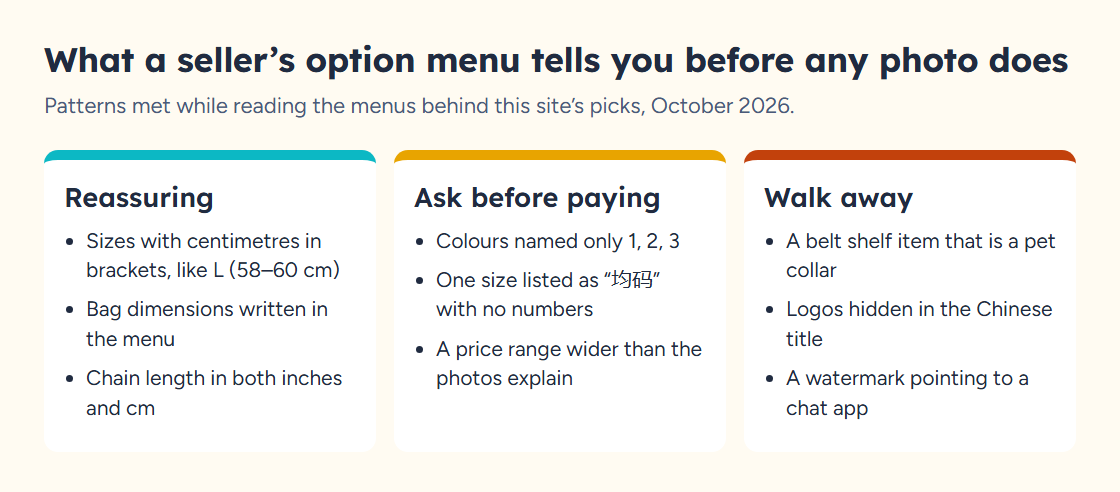
On Weidian, which most of our picks come from, there are no star ratings to lean on. The option menu is the best evidence of a careful seller. Look for sizes with numbers in brackets, bag dimensions in the menu, chain lengths in two units. Be wary of colours that are only numbers, of a one-size label on a garment that clearly comes in sizes, and of a price range wider than the photos explain.
Some stores reveal themselves in the Chinese title. A plain English title can sit on top of a Chinese one that names a famous label or calls the item a “version” of something; we drop those, and you should too. Another tell: shelf mistakes. On the belt shelf we found studded collars that the seller's own title calls dog collars.
Putting an agent's promises in writing
Trust here is not a feeling; it is what an agent puts in writing. A trustworthy agent publishes its storage period, its photo policy, its return window and its fees, and what it publishes matches what happens. Where its own pages disagree, as UIDBuy's do on the service fee and the photo count, ask support in writing before your first order and keep the answer.
- Can you reach a person? UIDBuy lists live chat at all hours and an email address.
- Is the estimator public? Hidden shipping prices are a bad sign at any agent.
- Is there a named company? UIDBuy names several; see UIDBuy at a glance.
- Does it say no to counterfeits in writing? UIDBuy's disclaimers do.
Items that earn their share of the parcel
Deciding what to buy starts with the parcel. The shipping often costs more than the item. A CN¥46 cap is cheap; the share of a parcel it uses is not. So judge an item by what it adds to the box, not only by its own price.
- Light and flat beats bulky: a tee costs little to ship, a puffer costs a lot by volume.
- Pick sizes you can verify from a chart, or items that need none.
- Prefer menus with clear options. A menu of twelve colours named 1 to 12 is a guessing game.
- Check what you are buying is one piece. Menus sometimes sell a set, sometimes one item from the set photo.
The picks on the shelves are chosen this way, and the reason line on each card says which test it passed.
Before you pay: six mistakes we see in carts
- Reading the size from the button instead of the chart.
- Ordering on a Friday evening and missing the 120-hour photo window over a weekend; check the photos as soon as they arrive.
- Forgetting that socks and underwear cannot be returned under the standard rules.
- Buying one heavy item that tips the parcel past the weight where cheaper lines stop.
- Expecting electronics to be tested.
- Assuming the dollar price is final; it is a conversion, and the shipping comes later.
For the warehouse side of these checks, read warehouse photos.